- Seller Universe's Newsletter
- Posts
- AI Shopping Agents Are Coming: What Ecommerce Brands Need to Know
AI Shopping Agents Are Coming: What Ecommerce Brands Need to Know

Seller Universe
February 04, 2026
If you run an ecommerce business long enough, you get good at ignoring hype.
Crypto was going to “change commerce.”
The metaverse was going to replace websites.
Voice commerce was going to kill keyboards.
Most of it… didn’t.
But there’s a shift happening now that’s worth paying attention to—not because it’s flashy, but because it quietly changes who your real customer is.
The rise of AI shopping agents

We’re entering an era where software doesn’t just recommend products.
It shops.
AI agents are starting to:
Search for products
Compare options
Filter based on preferences, price, availability, and reviews
And in some cases, complete purchases autonomously
The customer still sets the rules (“buy the best running shoes under $150”), but the decision-making is increasingly delegated.
That’s a meaningful change.
Why this is different from past hype cycles
This isn’t about a new channel or shiny frontend experience.
It’s about who controls the funnel.
Historically, ecommerce optimization meant:
Better ads
Better landing pages
Better email flows
All designed to persuade a human.
AI agents don’t care about:
Emotional storytelling
Clever copy
Brand vibes
They care about:
Structured data
Reliability
Price, availability, and constraints
Historical performance and trust signals
In other words, they behave more like procurement software than shoppers.
A quiet shift: humans choose brands, agents choose SKUs
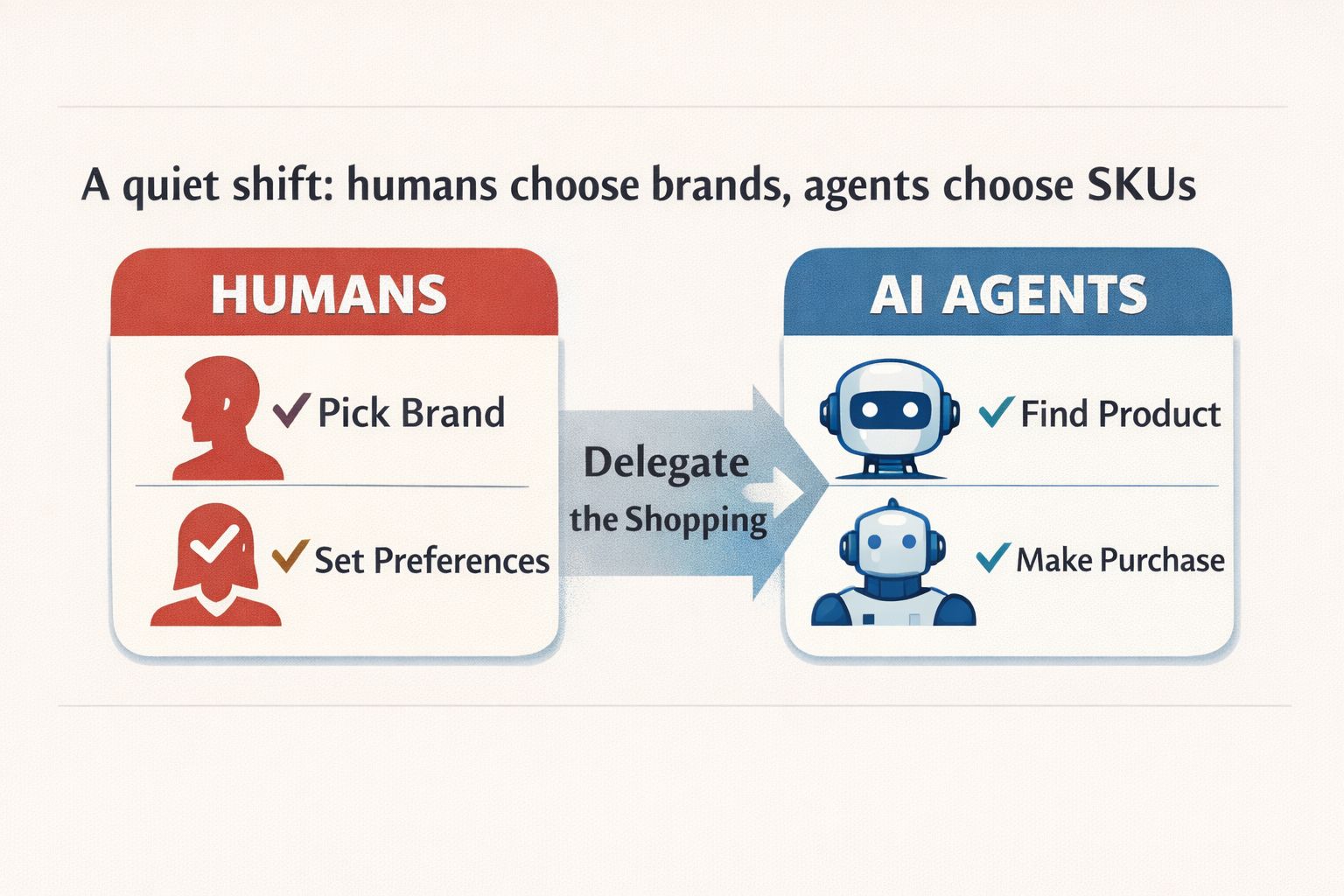
Humans still matter. A lot.
But increasingly, humans may:
Choose which brands they trust
Set preferences once
Then let agents handle repeat or utility purchases
Think reorders. Commoditized categories. Accessories. Replenishables.
That’s where things get interesting—and uncomfortable.
Because many ecommerce brands are optimized to persuade people, not to be legible to machines.
What smart operators should be thinking about now

No panic required. But some clear questions are worth asking:
How machine-readable is your catalog?
Clean data, consistent attributes, clear differentiation matter more when software is deciding.Are you winning on fundamentals?
Price consistency, inventory reliability, shipping speed, and returns suddenly become even more important.Where does your brand actually matter?
If an AI agent can swap you out for a cheaper alternative with similar specs, what’s your real moat?Are you building direct relationships—or just traffic arbitrage?
The more your value lives inside Google/Facebook/Amazon funnels, the more exposed you are.
The likely outcome (and the opportunity)
Most brands won’t be “replaced by bots.”
But many will be quietly deprioritized by them.
The winners will look boring on the surface:
Operationally excellent
Data-clean
Clear value propositions
Strong repeat behavior
Ironically, the brands that survive agentic commerce may look a lot like the ones that survived Amazon.
Not the flashiest.
Not the loudest.
Just… the best-run.
And as usual in ecommerce, boring tends to win.